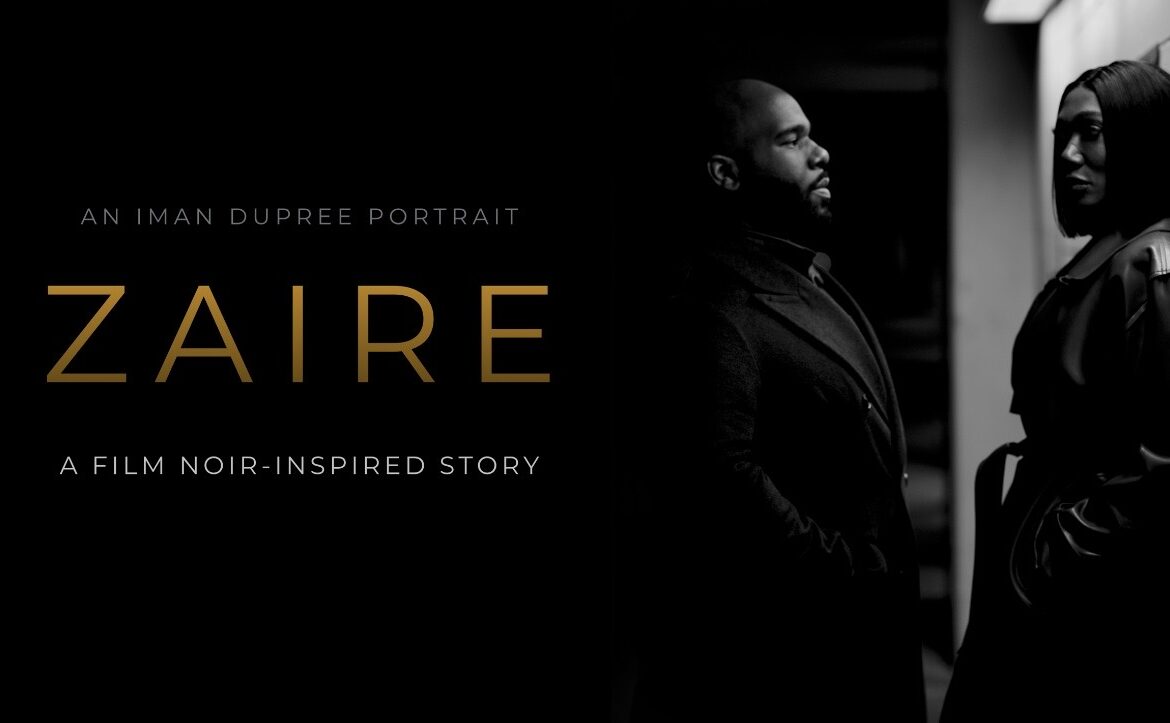
As COVID-19 lockdown restrictions begin to lift, Zaire, written and directed by Iman DuPree, unfolds with a quiet urgency as it explores societal expectations, yearning, intersectionality and the dehumanization of modern workers through a story of personal transformation in a world still adjusting to change.
Starring Carmen Banks as Zaire Okundaye, a Black woman of trans experience, and Benji as Marcus Johnson, a Black bisexual cis man, the film traces the emotional weight of navigating identity, connection and survival amid shifting realities.
Zaire, a driven executive, pushes for success while navigating a difficult merger, but after a discriminatory setback, a brief connection begins to take on deeper meaning. Meanwhile, Marcus, a charming but stuck loner, turns online to escape isolation, finding a fleeting sense of connection that fades with doubt by morning, leaving both searching for clarity and change.
After joining a private screening of Zaire,I sat down with Iman DuPree to talk about elements of their film. Zaire, thus far, has won three Best LGBT Film awards and has been selected for several film festivals.
Q: With the news articles and photos in the opening scenes that showcase some history, how did research help expand upon what you knew (or didn’t), which helped shape the production of Zaire?
A: I knew of that history from feminist readings and my enjoyment of underground media. Have you ever watched Halle Berry’s Catwoman? I knew that I wanted an opening montage like Catwoman had, which gives a silent history on some of our Black trans ancestors, and how they’ve been portrayed in the media. Juxtaposed with how Zaire opens, I feel it quietly explains what we’re dealing with upfront.
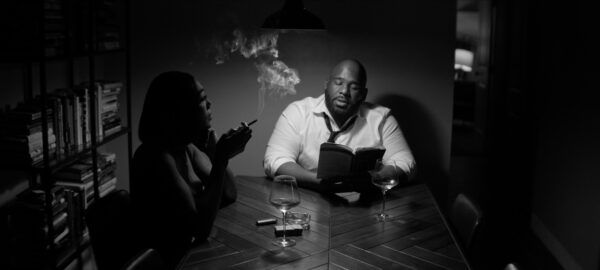
Ancestral guidance is one of the story’s themes, so I hoped to also depict the ancestors “spiritually” passing the baton to Carmen in the role of Zaire. My opening montage goal was to dispel the belief that trans identity is some new fad, which even predates the oldest record depicted in the montage. Although Zaire is film-noir-inspired, I wanted the noir crime trope to have nothing to do with the story, while still acknowledging our ancestors’ history.
Regarding the virtual meeting:
Q: The act of deciding whether to share her pronouns, to certain word choices in the conversation like “be prepared” and “welcomed”; in that brief window, was it laid out as a metaphor for life? And more specifically, life from the trans experience? Internal thoughts and realities?
A: Corporate mergers and acquisitions are truly about relationships, alignment and transition. So my aim was to show Zaire as a nurturing leader on the other side of a personal transition and at the brink of a professional one. In that moment, I feel Zaire advises her team to lead with the same empathy she deserves. Carmen’s inflections of those lines capture a way to edify the team’s post-merger approach while expressing what I believe Zaire most desperately wants: to feel welcomed. Like all of us. Like those on the receptive end of a corporate acquisition.
Q: Carmen & Benji together, especially that first link, truly showcased the excitement and glow when connecting for the first time. How were you able to transition what was written for the script so well visually?
There were moments of a true spark-filled experience on screen.
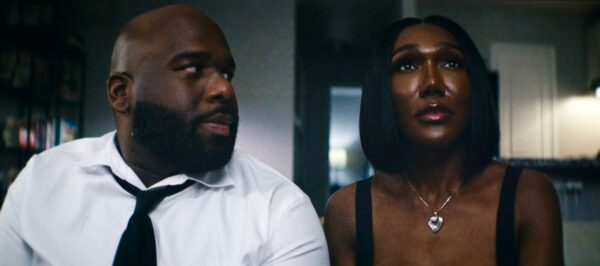
A: Carmen and Benji’s chemistry test proved that casting them was the best choice. The time they shared in that scene was so beautiful to me; it had to be shown in color. What’s witnessed there is a true collaboration. In the screenplay, for that sequence, time is not meant to be chronological. But I created space for a “spark” to still build organically.
Zaire and Marcus shift from adorably awkward to inaudible flirtatious banter, to bonding over a shared thing, which reveals more shared things. Also, in the edit: sound design, music supervision and visual effects that emulate 35mm film enabled me to create ways to shift the mood, despite shots from a mostly static camera position.
After Zaire’s line “I hate cell phones,” we improvised a lot and just had fun with it! I wanted to show people what’s possible when you put the phone down and pick up on something real.
Q: What lessons did you learn throughout this process that you can apply to future films?
A: That it is ok to NOT have all the answers. That’s where the curiosity is – where the magic is. I learned I must be fearless in my filmmaking. There were experimental vignettes of Zaire I opted not to do out of fear that people just wouldn’t “get it”. That was a mistake. One I won’t make again. I’m so excited for my next two projects. And I won’t hold back.
Q: How did the process of Zaire change throughout and how did it change you as a creative?
A: Zaire was never intended to be a feature film. [laughs] When DC became occupied, to keep the team safe, we rescheduled multiple times. I even left the country for a while. I soon realized I had to finish what I started. I’m so thankful that my team stood by this project so faithfully.
We had multiple reshoots. And I want aspiring filmmakers to know reshoots are not a bad thing; it’s course correction. When something feels misaligned, as the captain, you must redirect – especially when things don’t go as planned on set. But those reshoots cost us. I even sold my gear to cover the last one. But it was absolutely worth it.
Funding ran out before I cast the voice acting role of “Octavia.” Aaron (EP, “Troy”) stepped in to save the day, and the wonderful Venus Kii Thomas came aboard in post-production. You’d never know, though, because her in-scene chemistry with Carmen feels as though she were a part of the journey all along.
Q: How did it change you as a person?
As a person, creating this film inspired me to truly embrace being trans non-binary. Like Zaire, I wasn’t sure I was ready to vocalize that. Mainly because I don’t plan to medically transition, nor do I feel I have the androgynous look people may expect a trans nonbinary person to have.
I simply do not identify as a man. But manhood is still read onto me by the public. As Gil Scott Heron once said, “The revolution will not be televised. It [the revolution] will happen in your mind.” As a creative, I wish to explore that revolutionary landscape in my next feature film, OCEANS DEEP, and my short film we still cruise.
But until then, I hope this portrait inspires more people to promote inquiry into how they show up in the world.
Zaire is set to premiere this year and features poetry from Essex Hemphill, Britteney Black Rose Kapri and David Frechette. Preorder Zaire here.
DuPree’s next film is a “returning citizen’s character study that explores interconnectedness of oppression through an arthouse lens, shot in Black and white imagery in a world created on its own. It will explore nuisance in our society told from the returning citizen’s perspective, as well as the ones around them.